Lines That Last
Everyone talks about craft.
Most people mean aesthetic.
There’s a difference, and it shows up around year five.
THE INSTAGRAM PROBLEM
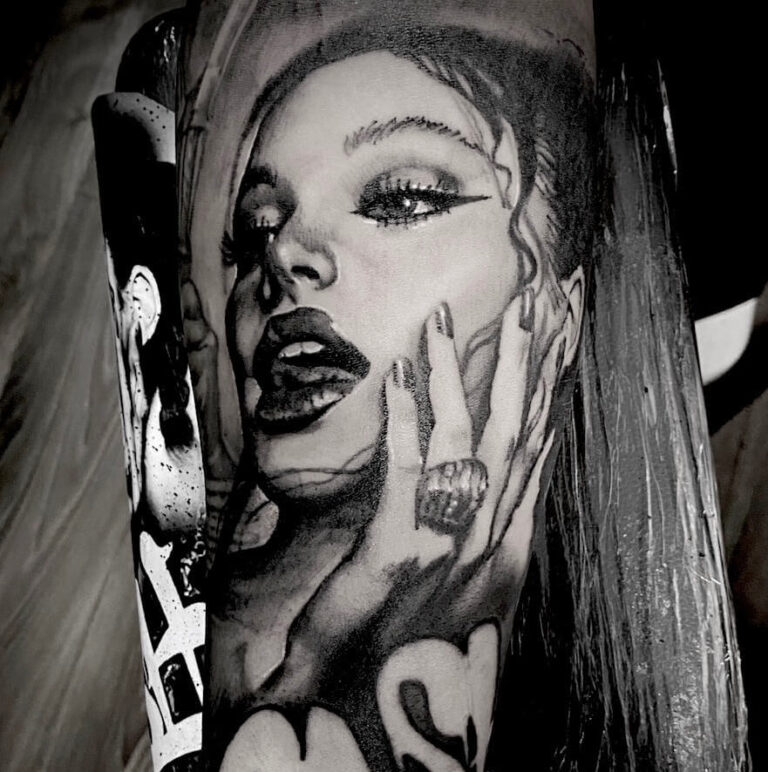
A tattoo photographed the day it’s finished can look like anything.
Soft gradients. Delicate linework. Intricate dot clusters packed tight enough to read as solid from three feet away.
It photographs beautifully. It gets liked. It gets shared.
Then five years pass.
Skin isn’t paper. It moves. It stretches. It ages. The immune system doesn’t care about your aesthetic – it just sees foreign particles and starts breaking them down.
Soft gradients blur into mud.
Delicate lines disappear.
Tight dot clusters merge into grey smudges.
The tattoo that looked perfect on Instagram now looks like a bruise with a vague outline.
That’s not bad luck. That’s predictable biology.
And it’s the difference between a tattoo optimized for the photo and a tattoo optimized for the skin.
─────────
WHAT “CRAFT” ACTUALLY MEANS
Craft isn’t about complexity. It’s about understanding the material.
A woodworker who ignores grain direction can make something that looks fine in the shop. But six months later, when humidity shifts, the joints split.
A tailor who doesn’t account for fabric stretch can make a suit that fits perfectly standing still. But the moment you sit down, the seams pull.
Tattooing works the same way.
Skin has grain. Skin has stretch zones. Skin has areas where ink holds clean and areas where it bleeds no matter how careful you are.
A good tattooer knows this before the needle touches skin.
They know that a forearm ages differently than a ribcage.
They know that black ink holds for decades while certain colors fade to nothing.
They know that a single clean line beats three overlapping “fix it later” passes.
They know that the body will do what the body does, and the job is to work with that, not against it.
That’s craft.
Not the complexity of the design. Not the trendiness of the style.
The understanding of how ink, skin, and time interact.
─────────
WHY SIMPLE WORK AGES WELL
There’s a reason traditional tattooing – the kind sailors got in the 1940s – still looks correct seventy years later.
Bold lines. Solid black. High contrast. Minimal gradients.
Not because tattooers back then lacked skill.
Because they understood what lasts.
They were working on sailors who’d spend months at sea, exposed to salt water and sun. They were working in shops with inconsistent equipment and no ability to “touch up” a client who shipped out the next morning.
So they developed a visual language that could survive.
Strong outlines that wouldn’t fade into nothingness.
Solid black fill that stayed readable even as the skin aged.
Simple shapes that didn’t rely on fine detail to communicate the image.
It wasn’t a stylistic choice. It was a functional one.
And it worked. Those tattoos are still here.
─────────
THE FIVE-YEAR TEST
Here’s a simple way to evaluate whether a tattoo is built to last:
Imagine it five years from now.
Not fresh. Not wrapped in plastic. Not photographed under studio lighting.
Just: five years of normal life. Sun exposure. Weight fluctuation. Skin doing what skin does.
Does the design still read clearly?
Do the lines still have definition?
Is the concept still communicated?
If the answer depends on every detail staying crisp, it’s not going to make it.
A well-built tattoo should be legible even when it’s aged. The outlines should still frame the image. The contrast should still guide the eye. The form should still make sense from across the room.
That doesn’t mean every tattoo has to be traditional bold-line work. Realism can age well if it’s built on a foundation of strong value contrast. Blackwork can hold for decades if the shapes are solid.
But detail for detail’s sake – micro-realism, ultra-fine line, elaborate geometric patterns where a single faded line collapses the whole structure – that’s a gamble.
And the house usually wins.
─────────
BLACK INK IS NOT BORING
There’s a misconception that black ink is the “default” choice – the thing you settle for when you don’t want color.
Reality: black ink is the most permanent, most versatile, most reliable material in tattooing.
It’s carbon-based. Your immune system can’t break it down the way it breaks down colored pigments. It doesn’t shift hue over time. It doesn’t fade to pink or green or grey-blue.
It just stays.
That’s not boring. That’s honest.
A black tattoo twenty years old looks like a black tattoo. A color tattoo twenty years old often looks like a faded watercolor left in the sun.
This doesn’t mean color is bad. It means color requires maintenance. Touch-ups.
Realistic expectations about how long certain pigments will stay vibrant.
Black just works. And it keeps working.
─────────
PLACEMENT MATTERS MORE THAN YOU THINK
A beautifully executed tattoo in the wrong place will age poorly.
Some areas of the body hold ink well: outer arm, upper back, thigh, calf.
Minimal stretching. Relatively consistent sun exposure. Skin that stays stable through weight changes.
Other areas are punishing: inner bicep, ribcage, fingers, feet.
Constant friction. Stretching with every movement. High turnover of skin cells.
You can execute perfect technique on a ribcage, and five years later it’ll look softer than the same design on a forearm. That’s not the artist’s fault. That’s anatomy.
A good tattooer will tell you this before you commit.
Not to upsell you. Not to gatekeep. Just to make sure you know what you’re signing up for.
Because a tattoo is a long-term contract with your body. And the body doesn’t negotiate.
─────────
WHAT WE OPTIMIZE FOR
Most studios optimize for the Instagram photo.
We optimize for decade ten.
That means:
- Strong outlines that won’t vanish as the skin softens
- Solid value contrast so the image reads clearly from a distance
- Placement that accounts for how that body part moves and ages
- Realistic expectations about what will hold and what won’t
It doesn’t mean we only do traditional work.
It doesn’t mean we refuse fine-line tattoos.
It means we build every tattoo – regardless of style – with a foundation that can handle time.
Because the photo is temporary.
The tattoo isn’t.
─────────
THE REAL CRAFT
Craft isn’t about impressing other tattooers.
It’s about making something that still works when the trend that inspired it is long dead.
It’s about knowing that your client will look at this tattoo in 2035 and still feel like they made the right call in 2025.
That’s the job.
Not the likes. Not the portfolio clout. Not the awards.
The decade-ten version of the tattoo.
Lines that last.
[END]
Alley Cat Tattoo – Bucharest, 2025